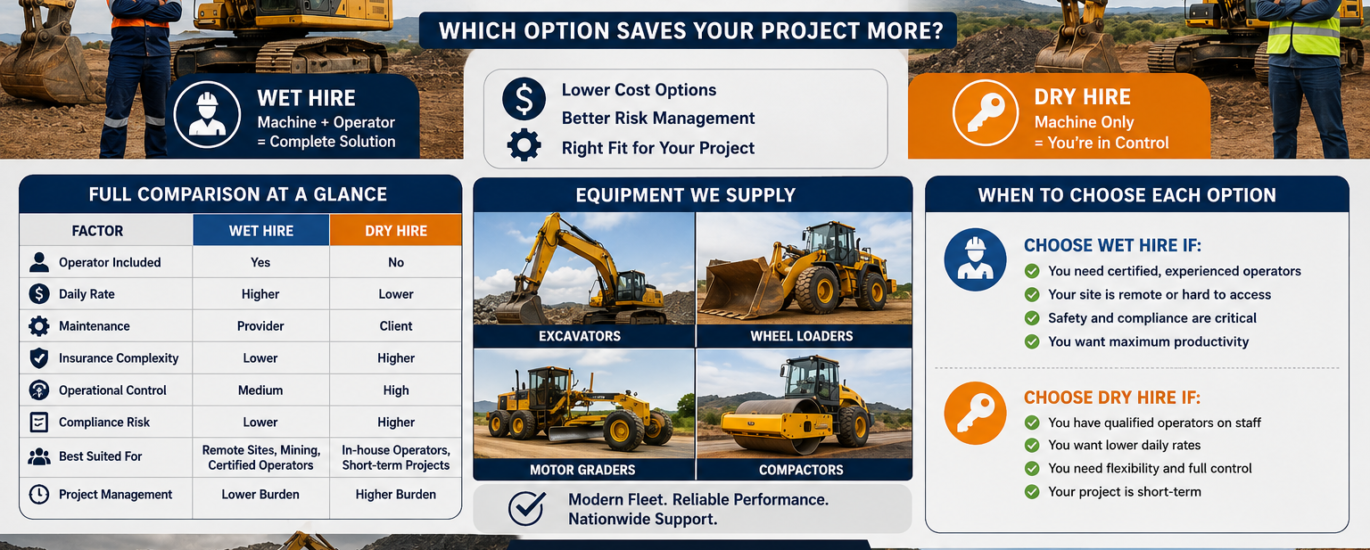
Wet hire vs dry hire Zimbabwe is one of the most common questions asked by project managers, mine operators, construction companies, and infrastructure contractors. Choosing the right hire model can significantly impact project costs, productivity, compliance, and risk management.
While both options provide access to essential earthmoving equipment, they differ in terms of operator responsibility, maintenance obligations, insurance requirements, and overall project control. Understanding these differences is crucial when planning a project in Zimbabwe’s mining, construction, agricultural, or road-building sectors.
This guide explains the key differences, compares costs, and helps you determine which option is best suited to your project.
Definitions: Wet Hire and Dry Hire
Understanding the basics is the first step in evaluating wet hire vs dry hire Zimbabwe options.
What Is Wet Hire?
Wet hire refers to equipment rental that includes a qualified operator supplied by the hire company.
A typical wet hire package includes:
- Earthmoving equipment
- Certified operator
- Scheduled maintenance
- Technical support
- Equipment management
The hire provider remains responsible for ensuring the machine is operated correctly and maintained according to manufacturer standards.
What Is Dry Hire?
Dry hire refers to equipment rental without an operator.
The client is responsible for:
- Supplying operators
- Daily equipment checks
- Site supervision
- Operational management
- Compliance oversight
Dry hire is commonly chosen by companies that already employ experienced machine operators.
Wet Hire vs Dry Hire Zimbabwe: Full Comparison Table
The following comparison highlights the major differences.
| Factor | Wet Hire | Dry Hire |
| Operator Included | Yes | No |
| Lower Daily Rate | No | Yes |
| Operational Control | Medium | High |
| Maintenance Responsibility | Provider | Shared/Client |
| Training Requirements | Minimal | High |
| Compliance Risk | Lower | Higher |
| Insurance Complexity | Lower | Higher |
| Project Management Burden | Lower | Higher |
| Best for Short-Term Projects | Yes | Sometimes |
| Best for Experienced Contractors | Sometimes | Yes |
When evaluating wet hire vs dry hire Zimbabwe, businesses should consider more than daily rates alone.
When to Choose Wet Hire
For many projects, wet hire delivers greater value despite the higher daily cost.
Mining Operations
Mining environments require specialised skills and strict safety procedures.
Wet hire is often preferred because:
- Operators understand machine limitations
- Productivity is maximised
- Safety compliance is improved
- Downtime is reduced
Many mining companies comparing wet hire vs dry hire Zimbabwe ultimately select wet hire for critical production activities.
Projects Requiring Certified Operators
Certain machinery requires experienced operators with specific competencies.
Examples include:
- Large excavators
- Motor graders
- Heavy compactors
- Production loaders
Hiring equipment together with an operator removes the challenge of sourcing qualified personnel.
Remote Sites
Remote projects present unique challenges.
Benefits of wet hire include:
- Faster mobilisation
- Reduced staffing requirements
- Lower training costs
- Better equipment monitoring
This is especially valuable in remote mining regions and infrastructure projects throughout Zimbabwe.
When to Choose Dry Hire
There are situations where dry hire is the better option.
You Already Employ Qualified Operators
Companies with established equipment teams often prefer dry hire.
Advantages include:
- Lower daily costs
- Existing workforce utilisation
- Greater operational flexibility
- Direct management control
In many wet hire vs dry hire Zimbabwe evaluations, large contractors choose dry hire because they already maintain skilled personnel.
Short-Term Equipment Requirements
Some projects require equipment for only a few days.
Examples include:
- Site clearing
- Temporary earthworks
- Emergency repairs
- Agricultural development
If operators are immediately available, dry hire may be the more economical solution.
Maximum Operational Control
Dry hire provides complete control over:
- Working hours
- Scheduling
- Task allocation
- Site management
This can be beneficial on projects with complex operational requirements.
What About Full-Service Contracts?
The discussion around wet hire vs dry hire Zimbabwe often overlooks a third option: full-service contracts.
When Full-Service Beats Both Options
A full-service contract typically includes:
- Equipment
- Operators
- Maintenance
- Fuel management
- Site supervision
- Technical support
This structure creates a single point of accountability and reduces administrative burden.
Long-Term Project Considerations
Full-service contracts are commonly used for:
- Major mining developments
- Road rehabilitation projects
- Infrastructure construction
- Multi-phase developments
For long-duration projects, they can provide better cost predictability than either wet or dry hire alone.
Cost Comparison: Real Zimbabwe Numbers
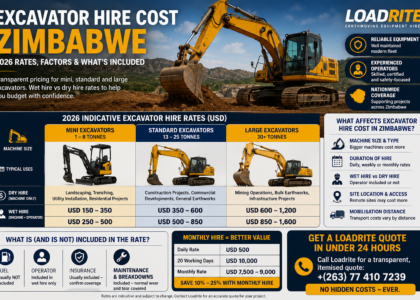
Cost is usually the deciding factor when comparing wet hire vs dry hire Zimbabwe solutions.
The figures below are indicative examples only and may vary according to machine size, project location, and contract duration.
Excavator Hire
| Hire Type | Indicative Daily Rate |
| Dry Hire | USD 350 – USD 600 |
| Wet Hire | USD 500 – USD 850 |
Wheel Loader Hire
| Hire Type | Indicative Daily Rate |
| Dry Hire | USD 300 – USD 550 |
| Wet Hire | USD 450 – USD 800 |
Motor Grader Hire
| Hire Type | Indicative Daily Rate |
| Dry Hire | USD 450 – USD 700 |
| Wet Hire | USD 600 – USD 1,000 |
Why Wet Hire Sometimes Costs Less Overall
Although daily rates are higher, wet hire may reduce:
- Downtime
- Equipment misuse
- Maintenance expenses
- Productivity losses
This is why many organisations reviewing wet hire vs dry hire Zimbabwe decisions look beyond the headline rate.
What Zimbabwe’s Mining and Construction Sectors Prefer — And Why
Different industries often prefer different hire models.
Mining Sector Preferences
Mining companies frequently choose:
- Wet hire for production equipment
- Full-service contracts for large projects
- Dry hire only when skilled operators are readily available
Safety and productivity are usually the primary concerns.
Construction Sector Preferences
Construction firms often favour:
- Dry hire for routine equipment needs
- Wet hire for specialised machinery
- Full-service support on large infrastructure contracts
The choice largely depends on workforce availability and project duration.
When discussing wet hire vs dry hire Zimbabwe, there is no universal answer. The best solution depends on operational requirements.
How Loadrite Structures All Three Options
Loadrite understands that every project has unique requirements.
Dry Hire Solutions
Loadrite dry hire includes:
- Modern equipment
- Scheduled servicing support
- Flexible rental periods
- Nationwide availability
Wet Hire Solutions
Loadrite wet hire includes:
- Experienced operators
- Equipment management
- Technical support
- Reliable mobilisation
Full-Service Contract Solutions
Loadrite full-service contracts provide:
- Equipment fleets
- Operators
- Maintenance
- Project support
- Long-term operational solutions
This flexibility allows clients to choose the most cost-effective approach when comparing wet hire vs dry hire Zimbabwe alternatives.
Frequently Asked Questions
Which is cheaper: wet hire or dry hire?
Dry hire generally has a lower daily rate. However, wet hire can sometimes deliver lower overall project costs through improved productivity and reduced downtime.
Is wet hire safer?
In many cases, yes. Qualified operators supplied by the provider often improve compliance and reduce operational risk.
Can I switch between wet hire and dry hire?
Yes. Many projects start with wet hire and later transition to dry hire once operational requirements change.
What industries commonly use wet hire?
Mining, road construction, civil engineering, and infrastructure development projects frequently use wet hire arrangements.
How do I decide between wet hire and dry hire?
The best approach is to assess operator availability, project duration, site conditions, compliance requirements, and overall project objectives.
Recommended Resources
For additional industry information:
- Chamber of Mines Zimbabwe
- Zimbabwe National Road Administration (ZINARA)
- Construction Industry Federation of Zimbabwe
- Ministry of Transport and Infrastructural Development
Not Sure Which Option Fits Your Project?
Choosing between wet hire vs dry hire Zimbabwe solutions can have a major impact on project performance, safety, and profitability.
Loadrite can help you assess your requirements and recommend the most suitable option for your project.
Call Loadrite and we will advise you in minutes: +(263) 77 410 7239